|
|
Off to the Orchard.
|
Paul Plum is a grower and marketer of tree and vine ripe
fruits, with an emphasis on stone fruit, pears, and melons.
Closed for 2008. Thanks for coming by.
I look forward to seeing you in 2009!
Home Grown
100% of the produce sold at the Paul Plum stand is Home Grown on
the slopes of a hidden valley above the Susquehanna River in Bradford
county, Pennsylvania. In general, because of our harsh climate, a number
of cultivars grown by Paul Plum are not recommended for propagation in
the Eastern United States.
Therefore, many of our fruits can not be found growing elsewhere in
Northeastern Pa.
|
|
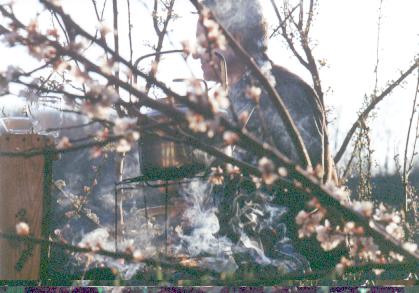
Spring Frost watch, and a cup of tea.
|
|
The French axiom that the finest full bodied wines come from grapes grown
on the edge of their culture, may also hold true for some other fruits
as well. Certainly with desire, hard work, and the warming and nurturing
influences of the Susquehanna River, a great variety of often exotic, and
always delicious Tree Ripened fruits are available weekly.

Stone Fruit
A word about Stone Fruit i.e., cherries,
apricots, plums, peaches and nectarines. Unlike pome fruits
(i.e., apples, pears, quince), stone fruit stops natural ripening
once picked. Fruits that grow far away must be picked immature to
survive the journey to market. When these trucked in fruits are
placed in a bowl on your dining room table, or in a brown paper ripening
bag, they soften and lose some acidity, but natural sugar conversion
does not take place, usually leaving the fruit tart, mushy, and bland.
Paul Plum stone fruits are left on the tree to fully ripen,
then picked daily and rushed into the cooler to remove field heat. Please
come in and taste our tree ripe stone fruit!
Sweet Cherries
|
|
Looking close-up. Avoiding unnecessary spraying.
|
The first fruit of the season is Sweet Cherries. Here it takes 24 hour
vigilance if ripe cherries are to be picked.
Multi-noise makers, the frequent boom of a propane bird cannon,
even human presence doesn't deter the birds, raccoons, opossums, and
turkeys from having a sweet feast. The valley is not hidden to them.
Sweet cherries ripen late June to early July.
Tart Cherries
Some prefer to call them pie cherries because they make
delicious pies. Others like the tart taste and eat them
out of hand. My tart cherries, Balaton, are red inside
and out. They ripen right after Sweet Cherries.
Apricots
After sweet cherries are picked, there is a week or two delay before
the main season fruits come in. Apricots and plums compete to be next.
Apricots usually win by a day or two. Of all the major fruits apricots
are the hardest to grow in the Eastern United States. That is why most
Pennsylvanians have never tasted a sweet, tender, delicately aromatic
tree ripened apricot. They are outstanding! My favorite fruit! If you
have never tasted a tree ripened apricot, please don't deny your taste
buds one of life's great treats. Come down and I'll give you a taste.
Plums
Paul Plum probably grows more varieties of Plums than anyone else in
Northeastern Pennsylvania. Here, plums ripen from July to October,
There are yellow plums, red plums, black plums, and colors in between.
Some weeks a bonanza of cultivars ripen.
|
|
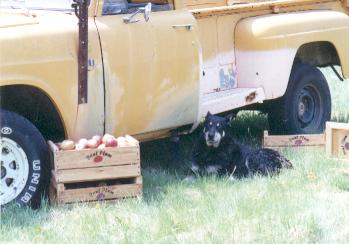
Hidden camera nabs orchard-hand Jockie Barker laying down on the job!
Not only demoralizing for other crew, but ultimately the consumer pays
with higher fruit prices. :-)
|
|
The plum, perhaps the sweetest
of domestic fruits, must spend its time on the tree developing sugar
until it is dead ripe, not in the back of a truck heading east! Just ask
any opossum what the sweetest fruit in the orchard is. Opossums may be
indecisive crossing the road in front of your car, but walking through
a grove of fruit trees they will make a bee-line to the plum tree with
ripe fruit. Opossums demand full sugar, but then, so do I.
Peaches and Nectarines
Tree ripe Peaches are a fruit many people can scarcely
wait for. My peaches and Nectarines, (mostly yellow
fleshed, but some white) generally span from the second
week of August to early October. Many White peaches are
sweeter and more aromatic than yellow ones, but some are
harder to transport, so are seen less frequently. Rariton
Rose, one of my white peaches, is an ole time favorite and
should be at the stand about the third week of August.
Newer, easier to transport white varieties will also be
available this summer.
Super sweet donut peach, Saturn, plus Blushingstar, Summer Pearl, and
super sweet White Lady, round out the whites.
|
|
Lunch break - Jockie's too tired to eat...
|
|
I've had people come up to me and eulogize peaches but don't want to
taste a Nectarine because they know they will hate it.
Nectarines are just fuzz-less peaches.
True, a particular cultivar of
nectarine may taste slightly different than your favorite peach, but
your favorite peach will probably taste slightly different than another
cultivar of peach. My nectarines start ripening in mid August.
Some of my biggest and tastiest peaches ripen in late September to early
October.
|
QUIZ:
|
Where can you find tree ripe peaches in October?
|
|
ANSWER:
|
At Paul Plum's stand and virtually nowhere else.
|
Pears
Pears, properly ripened are a delight. How "un-stone
fruit" they are. They must be picked before tree ripe and cooled to
approximately 38 degrees for a week or two, then brought up to room
temperature where they will ripen in a few days. Given this treatment
the fruit turns buttery sweet with no grit cells. Paul Plum has a number
of outstanding cultivars, such as Aurora, Concord, Bosc,
and Asian varieties Hosui, Yoinashi, and Olympic Giant.
If you love pears, and have an extra refrigerator to store them in, you
can have freshly ripened pears until February. Just take the number of
pear you wish to consume each day out of the refrigerator and ripen on
the table.
Apples
Of course Paul Plum has Apples. Starting in late August
and early September with Ginger Gold, Sansa, and Gala, and ending with
varieties ripening into late October.
Melons
Melons. Each year I can't wait to sink my teeth into one.
The area where the melons grow, must be the "heaven" of the garden.
Paul Plum grows only the Athena cultivar. Athena melons are not the
earliest to ripen, but the extra days of waiting are worth it if you
like the very best. Great effort is made to have some of the earliest
home grown Athena's in our area.
|
|
Hiya! I'm a Baby Athena. When I grow up I'm going to have the
nicest and biggest melons in all of Northeastern PA!
|
These melons are picked full slip, not half slip as are those that
must be shipped in. My melons remain on the vine, increasing their
sugar until the mother vine says "enough, I'm weaning you," and stops
its nourishment. At this stage the slightest touch and the melon pops
off the vine. Even the gravitational pull of the hill sometimes causes
a ripe melon to detach. I plant at two or three staggered dates each
year, assuring a steady flow of fresh melons from Early August until
cold weather.
Tomatoes
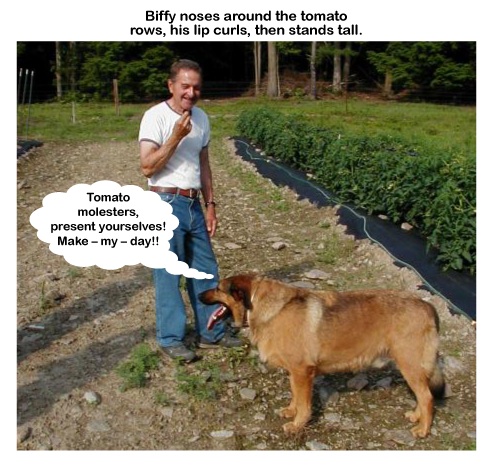
People are often disappointed if they don't find Tomatoes
at the Paul Plum stand, so I grow number of tasty slicing tomatoes,
plus have some extra for those that wish to can their own.
Raspberries
Paul Plum Red Raspberries are at the stand from late
August until November.